If you are planning a trip to Vietnam and need to check the Vietnam Public Holiday schedule, this overview covers the official public holidays in Vietnam 2026, answers common questions about these special dates, and provides useful advice for travelers.
Vietnam Public Holidays 2026
Understanding Vietnam Public Holidays 2026 can make a big difference when planning your trip, event, or business schedule. These holidays often shape how cities move, how services operate, and what kind of atmosphere you will experience in each destination. Vietnam’s mix of cultural celebrations and national observances also brings unique moments that many travelers enjoy witnessing. This overview gives you a simple, helpful starting point to plan a smooth and well-timed journey in 2026.
Discover more MICE events and tours in Vietnam. Leave us a message and our team will get in touch with you soon.
List of Vietnam Public Holidays 2026
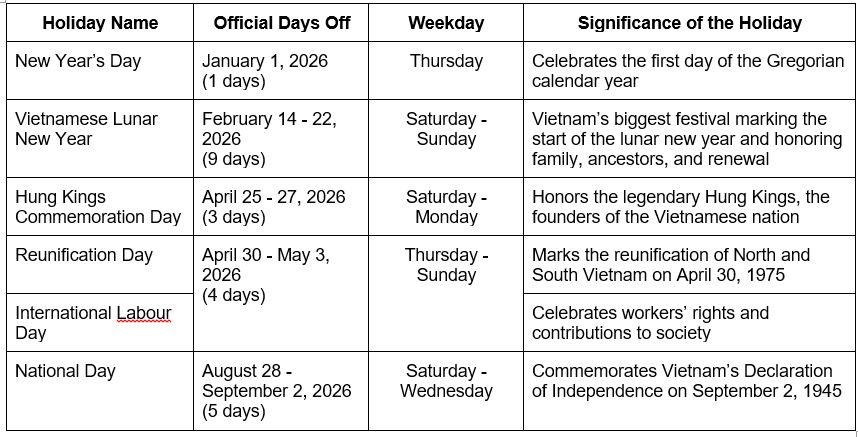
In 2026, Vietnam will observe six main national holidays with official days off, including New Year’s Day, the traditional Lunar New Year, the Hùng Kings’ Commemoration Day, Reunification Day, International Workers’ Day, and National Day.
Below is the holiday schedule applied to government officials, public employees, and civil servants who follow a five-day workweek with Saturdays and Sundays off.
New Year (1 January)
Vietnam observes a 1-day public holiday for New Year’s Day, which in 2026 falls on a Wednesday. Regular activities resume on the following days. On New Year’s Day, you can expect lively countdown events in major cities like Hanoi, Da Nang, and Ho Chi Minh City.

Vietnam Lunar New Year (February 14 to February 22, 2026)
The Lunar New Year in Vietnam is based on the Lunar Calendar. In 2026, the country will celebrate this traditional holiday with a 9-day break. During this period, administrative activities come to a halt as people return to their families and communities to take part in various gatherings, festivals, visit pagodas, and engage in traditional customs. It is a time of deep cultural significance, where family gatherings and religious rituals take center stage.

Hung Kings Commemoration Day (26 April)
This holiday is a time for Vietnamese people to honor their shared national heritage. In 2026, the Hung Kings’ Temple Festival follows the Lunar Calendar, falling on 10 March (Lunar), which corresponds to 26 April (Gregorian). This year, it lands on a Monday, and there is a 3-day public holiday ( 25, 26, 27 April). The festival attracts a large number of people to the “ancestral land” in Phu Tho, where they take part in the Hung Kings’ Temple celebrations, paying tribute to the legendary founders of Vietnam.

Vietnam’s Reunification Day (30 April)
Reunification Day marks the end of the Vietnam War in 1975 and carries historical significance for many Vietnamese. Cities may hold ceremonies or small public events, while families often use the occasion to rest or travel. Since it falls just one day before International Labour Day, the two dates naturally connect to form a longer holiday period that encourages domestic travel.

Vietnam celebrates International Labor Day (1 May)
This holiday recognises workers nationwide. It is less ceremonial and more of a well loved break when locals unwind, enjoy short trips or meet friends. Because it immediately follows Reunification Day, many people benefit from an extended stretch of days off, making tourist areas busier than usual.

Vietnam’s Independence Day (2 September)
National Day celebrates the birth of modern Vietnam. You will see national flags lining balconies, streets and public squares, creating a vibrant and unified atmosphere. In 2026, adjusted work schedules allow many people to enjoy up to five consecutive days of holiday, giving both locals and visitors time to travel, relax or join small festive events happening in major cities.

Tips for Planning Your Trip
If your trip happens to fall on these special days, a few friendly reminders can make your journey smoother.
Travel Rush During the Holidays
Many Vietnamese travel during the holidays or return to their hometowns, which means well loved destinations can feel lively and busy. The festive energy is part of the experience, yet it is wise to reserve your accommodation in advance so you do not face limited options or higher prices.
Check Opening Hours in Advance
During major celebrations such as Tet or National Day some family run shops and small local eateries may close for the first days of the holiday. In big cities like Hanoi you may want to check opening hours on their social platforms before heading over.
Secure Your Transport Early
Travel demand usually increases before and after long holidays. Buses, trains and flights are often booked out quickly, so securing your tickets early will help you avoid last minute changes.
Enjoy Cultural Experiences
Festive periods like the Hung Kings Commemoration Day or the Lunar New Year also offer a wonderful chance to witness authentic Vietnamese traditions. Visiting temples, watching local ceremonies or simply observing how communities celebrate can become memorable highlights of your trip.
Public holidays offer a wonderful opportunity to experience Vietnam at its most vibrant, letting you share in the celebrations that mean so much to local communities. Hope these insights help you plan a memorable journey through Vietnam in 2026.
FAQs
Q: Why should you check for Vietnam Public Holidays 2026?
A: Travelers should check Vietnam’s public holidays to finalize their plans, apply for visas early to avoid paperwork issues that might hinder entry, and book flights and hotels in advance. This also helps in avoiding peak domestic travel times or allows you to either join in on major events or choose destinations that align with your travel preferences.
Q: How many public holidays are there in Vietnam?
A: There are 6 official public holidays celebrated nationwide, including New Year, Lunar New Year, Hung Kings’ Commemoration Day, Reunification Day, May Day, and National Day. Among these, the Lunar New Year and Hung Kings’ Commemoration Day follow the Lunar Calendar.
Q: Does Vietnam celebrate other festivals?
Yes, Vietnam hosts thousands of large and small festivals throughout the year, including traditional festivals, regional events, commemorative events, and celebratory occasions. Notable festivals include:
- Cold Food Festival (3 March – Lunar)
- Double Fifth Festival (5 May – Lunar)
- Ullambana (15 July – Lunar)
- Mid-Autumn Festival (15 August – Lunar)
- Victory at Dien Bien Phu Commemoration (30 April 1954)
- Carnaval Halong (end of April to beginning of May)
- Da Nang International Fireworks Festival (June to July)
- Hue Festival (starting on March 25)
You can participate in these festivities allowing you to immerse yourself in the local atmosphere and gain deeper insights into the culture of your destination.
Q: When is New Year in Vietnam?
A: Vietnam celebrates both the Gregorian New Year with a 1-day holiday and the traditional Lunar New Year, known as Tết. Tết is considered significantly more important as it is tied to themes of heritage, family reunion, spirituality, and belief. Additionally, the holiday period for Tết is typically longer than that for the Gregorian New Year.
Q: Does Vietnam celebrate Halloween, Valentine’s Day, and Christmas?
A: Yes, Vietnam celebrates these events. However, they do not entail public holidays, so people generally continue with their regular work schedules. During these occasions, shops and shopping centers decorate according to the themes to attract customers and promote their products. The level of celebration varies among the Vietnamese population, often depending on religious beliefs and cultural practices.
Q: What should you do when traveling to Vietnam during Public Holidays 2025?
A: You can travel normally if you visit Vietnam during public holidays. However, there will be some impacts, such as government offices being closed. During Tết, supermarkets, shops, and restaurants may close for 1 to 3 days. Therefore, travelers should book services in advance, as costs may be higher than usual. If you want to immerse yourself in the festive atmosphere, it is easy to do so by observing the celebrations, shopping, or participating in various recreational activities.
Q: Are all businesses closed during public holidays in Vietnam?
A: Not all businesses are closed. However, a limited number remain operational. Certain essential services, such as visa processing, tours, hotels, and entertainment, continue to operate, although costs may be higher than usual. It is best to prepare in advance to ensure you can access the services you need during public holidays.
Q: Are there any specific dress codes for attending festivals and events during national holidays?
A: No, you just need to dress politely as you normally would. However, if you plan to visit temples, it is important to dress more modestly, which means wearing tops that cover the chest and shoulders, and pants that extend past the knees. During traditional holidays like Tết, you can try wearing a traditional áo dài or a modern version of it.
Q: Where should you go in Vietnam during public holidays 2025?
A: If you want to immerse yourself in the festive atmosphere, head to the major cities like Hanoi, Da Nang, and Ho Chi Minh City. This year, Hanoi will celebrate its 80th anniversary at the beginning of September. Additionally, Hue will host events for the National Tourism Year, with the opening ceremony scheduled for 15 March.
If you prefer retreat destinations, you might consider Ha Giang, Ninh Binh, Quang Binh, Nha Trang, or Phu Quoc.
Explore more travel suggestions and updates for Vietnam & Indochina Travel on our Website | Facebook | Instagram.